
Activism First, Truth Later
The PEN America debacle shows that, for some writers, accurate reporting is less important than the anti-Israel cause

I try to stay out of debates involving my fellow Jews and my fellow writers, two groups of people who, when challenged, can suck one into endless cycles of exhausting debate, wasting time that I should rightfully spend watching World Cup matches or reading books about surfing and spirituality. Speaking of which, here is my latest find:
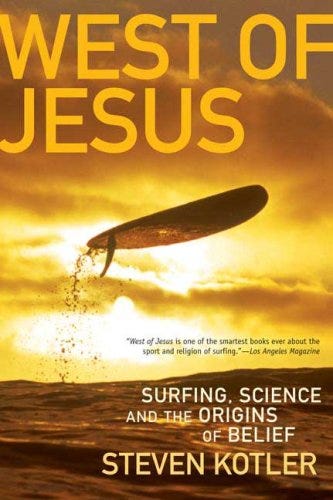
(I’m almost done with it. It’s pretty good.) But sometimes a thing happens in the world that requires me to take my puppy off my lap, rouse myself from my sofa, and opine. Speaking of that new puppy, here is Nigel:

The thing that happened that forced me to take Nigel off my lap, after which he put himself into voluntary exile in his crate, was that PEN America issued a report about a real thing that is happening—the publishing industry has, to some extent, turned against works by Israeli and Jewish writers in the last couple years—and PEN’s president resigned because this truth might prove bad for his pet cause.
The short report by PEN, a free-speech organization which I am not a member of (I’m not a member of much, besides my shul and Friends of Edgewood Park; I let my membership in the Straus Family Historical Society lapse) says something that should not be controversial, which I can sum up with this excerpt, from the beginning of the piece:
Jerusalem-based literary agent Deborah Harris represents dozens of leading voices of Israeli literature, from established titans to debut authors of “literary gems.” Her agency typically sells five to 10 literary novels a year into the United States. Since Oct. 7, 2023, they have not sold a single one.
Harris told PEN America that editors with whom she has worked for years simply don’t respond to her submissions, or reject them outright. She has been asked by some editors not to submit Israeli authors in the future.
“The standard line is, ‘I wouldn’t know how to publish this author right now,’” she said in an interview with PEN America. “Right now, we’re completely in this place where no one will even look. No one believes they can get a book that they love through an editorial meeting.”
In interviews with PEN America, more than 30 Israeli and Jewish writers and literary professionals described a widening cultural isolation since the attacks of Oct. 7 and the subsequent war in Gaza. Many spoke of rising hostility and exclusion both domestically and internationally that has taken a heavy and worsening toll.
This is a reality that has been documented by a few watchdogs for a while now (Erika Dreifus being one), and it’s good to see PEN reporting this news. And doing so should not be controversial. It takes nothing away from the horrors suffered by writers in Gaza, or discrimination faced by pro-Palestine writers and intellectuals, to speak out loud the truth that some Israelis and Jews are being discriminated against by the publishing industry. Indeed, given the reality of unconscious bias in the world (a reality that the left has done much to awaken us to), and the anti-Israel slant of the literary community, it would be surprising if this bias didn’t exist. And it would seem pretty basic that if there is discrimination in publishing, we’d want to know about it; and an organization like PEN should play a role in publicizing it.
So what’s the problem?
Well, there was a big problem, according to PEN board president Dinaw Mengestu, the novelist, who resigned his position (unpaid position, I think—I think he’s a volunteer board chair, not staff) over the report that his own organization promulgated. Here is what the Times wrote:
Dinaw Mengestu said he resigned as president of the free expression group PEN America on Thursday, in part because of an article about Israeli and Jewish writers in which the group outlines its opposition to cultural boycotts.
He called that approach “unethical” because it could portray the Boycott, Divestment and Sanctions movement, which seeks to economically isolate Israel because of its treatment of Palestinians, as discriminatory conduct instead of protected political speech. In an email, PEN America said it rejected any effort to read the article that way.
“We have the responsibility,” Mengestu said in an interview on Friday, “to be conscious and aware of how our work can impact and influence those debates, and especially if that means producing work that might actually restrict or limit or suppress what is constitutionally protected speech.”
Okay, to unpack this: PEN opposes cultural boycotts because—as the authors write in the report—they “believe that such boycotts threaten the free expression rights not only of those associated with the boycotted institutions but also of those in the countries where the boycott is practiced.” But many anti-Zionists see boycotting Israel, through the BDS movement, as a key tactic of opposition. So there is a tension there: Mengestu’s organization is against boycotts, but he is personally for them.
For what it’s worth, the report added that individual boycotters are exercising a free-speech right: “PEN America also recognizes that participating in or advocating for boycotts is an exercise of free expression, and we defend the rights of writers to do so without facing retaliation.” It’s just that the organization opposes boycotting as a tactic. And has reasons for doing so.
But that was not satisfactory for Mengestu, who worried that the existence of a piece that recognized that tension around boycotts, but which also told, sympathetically, the stories of Israelis and Jews who felt they were being discriminated against, would be bad for his cause. That is, Mengestu sees de-platforming Israelis, in part by not publishing them, as a form of noble, protected free speech, in service to a cause he believes in; but the PEN report treated their struggles to get published as evidence of a form of discrimination.
In reality, a boycott can be both: a political tactic for a cause one believes in, and—by definition—a form of discrimination. It can be for the greater good (or not), and still have real human costs. We should be able to talk about all this, which is what the PEN report did.
But here is the really troubling thing: Mengestu believes that certain truths should not be spoken because they are bad for The Cause. When he says, “We have the responsibility to be conscious and aware of how our work can impact and influence those debates, and especially if that means producing work that might actually restrict or limit or suppress what is constitutionally protected speech,” he is saying that before speaking a truth, we have to ask whether bad people will use that truth against us.
But that’s not what intellectuals and writers are supposed to do. We are supposed to speak truths no matter what—even if, or especially if, they aren’t convenient for us.
Honest intellectual inquiry isn’t for everyone. I always asked my students aspiring to journalism, “If you came across a story that was bad for a cause you held dear—abortion rights, or death penalty abolition, or wind power—and you knew that if you published the story, it would be seen as a major defeat for your side, would you publish it? If the answer is ‘No,’ probably you should find another line of work.”
Many writers fail this test. Here is Sara Schulman, on Facebook, defending Mengestu:
However, Dinaw had to resign this week (in a 15 page letter) because the Pen Blog went over his head to run one of those fake anti-semitism pieces about how “Jewish and Israeli” writers are being discriminated against. Dinaw is one hundred percent correct that this kind of fake victim propaganda can be used to support anti-Boycott legislation which violates the First Amendment and is everywhere as popular support for Palestinians grows.
Note that Schulman offers no evidence that anything in the PEN report is untrue; it could all be correct, but is still, to her, “fake anti-semitism” and “fake victim propaganda.” Worse still, from her point of view, it “can be used to support anti-Boycott legislation.”
Mengestu tried to clarify his position by attacking, on Instagram, Gal Beckerman’s Atlantic piece on this controversy. Go read Mengestu’s Insta-post. You’ll note that he spends much of it defending BDS movements on campus; he says not a word about real writers, far from campuses, who are seeing their novels rejected because of their ethnicity or nationality. Again, one can have a real debate about whether they are simply collateral damage in a war of ideas that must be fought; but one has to at least acknowledge the reality on the ground, in order to have that debate. After reading Mengestu and Schulman, one still has no firm sense to what extent they believe the story about writers having a hard time publishing is true; and if they think it’s a lie, they can’t tell us why.
Here let me say that I don’t like anti-boycott legislation (I also don’t like cultural boycotts). I am for the free speech of everyone, including anti-Zionists, uber-Zionists, monarchists, Mamdani stans, smoothie influencers, looksmaxxers, and Canadians. But the reason not to publish something can’t be that it can be weaponized to further anti-boycott legislation; the reason would have to be that it’s untrue. If it’s true, publish away.
On another note, I am struck by the coldness of Schulman’s Facebook post, the ruthless, calculated, political tone. What if, Instead of writing, “As long as we (Jews and Americans) are funding, supporting, and committing genocide, brutal occupation, and devastating apartheid, the world has the obligation to oppose Israeli state sponsored institutions,” she had instead written, “Look, cultural boycotts have victims. If a UK publisher boycotted American writers because of our current president’s warmongering ways, and all of a sudden I lost my UK publisher, and the check that comes with UK publication, a check I was counting on for my mortgage, I’d be peeved. I’d also have a bitter sense of irony about the whole thing, because I am an anti-imperialist voice at home, and ensuring that I sell fewer books helps Trump, if anything. But I also believe in political boycotts, and ultimately I’d have to direct my anger toward Trump rather than toward the UK publisher. It would suck, but life sucks sometimes. So I say to some of the Israeli writers caught in the crosshairs of this: We know that some of you hate the Gaza war [or apartheid, genocide, whatever] as much as we do, and we’re sorry that your careers are affected by this. Let’s all end the war and end the occupation and get back to reading good books in translation!”
Schulman could have written something like that—but instead she erased the actual people involved and whinged about “fake victim propaganda.” No reason it had to be that way.
Music for you
A dear reader told me she likes my music suggestions, so here’s another one:
A theologian and a poet walk into a bar
In Arc last week, we published a review by Blake Smith of Glimmerings, a new book cowritten by poet Christian Wiman and theologian Miroslav Volf. It’s an epistolary book, a collection of emails written back and forth between the two friends, expanding on conversations they had during long walks through New Haven. One reader of the review, a major scholar in her own right, called it, admiringly, “devastating,” which makes it sound like it trashes the book under review. I don’t think that’s right. The review has some negative things to say, about two writers who generally receive adoration; Smith doesn’t love Wiman’s poetry, and he thinks Volf’s theology is sometimes incoherent. But the “devastating” also has a positive tinge, I think; beautiful music can be devastating. And Smith is one of those critics whose work is devastating in both ways; he can be ruthlessly clear-eyed about another writer’s failings, but he offers such a deeply engaged reading of the books he writes about that his reviews are a testament to the project of criticism, in a beautiful way. I’d be happy for one of my books to be worthy of his devastation. Read the review here.
Joyce Maynard on her estranged child
Readers of this newsletter know of my love for Oldster, a web magazine about being 50+ (like me!). Two of its features are the monthly “Ask a Sober Oldster” series, featuring interviews with ex-drinkers like Anne Lamott, NPR’s Neda Ulaby, and songwriter Rhett Miller, and the weekly Oldster Magazine Questionnaire, which this week features Joyce Maynard (whom I got to know a little when she returned to Yale in her sixties as an undergrad, then later when I interviewed her for my Judy Blume biography). Excerpt, on her estranged child:
But Jim’s death wasn’t my greatest challenge. In my life as a parent, I have struggled with the choice of one of my three adult children, to remain largely distanced from me, which has also meant that I have not gotten to experience the joy—no doubt, incomparable—of knowing and being known by his children.
Estrangement from an adult child has reached epidemic proportions—particularly in middle class American culture, but those on the receiving end seldom speak of the pain that accompanies the decision of a beloved child to distance themselves or cut their parent off entirely. I’ll mention my sorrow on this front here, though it remains the absolute hardest part of my life, because I know this experience is shared by a surprising number of parents of adult children these days—loving, flawed people, who made mistakes as parents always do, but never failed to love their child, never dreamed they wouldn’t be a part of their child’s life, and their grandchildren’s lives, in a meaningful way.
Few of those who experience some form of estrangement speak about it, because there’s so much shame attached. I speak about this here out of the knowledge that so many parents of my generation—including, no doubt, some reading my words here—are going through this, and feel alone in their grief. I want to say, they are not alone.
But even this most painful experience has brought with it lessons. Radical acceptance being one of these. And the realization that it is possible to know great sorrow without surrendering one’s joy. I would have loved to have had the opportunity to be an active and involved grandmother in the lives of my older son’s three children—and who knows, maybe one day sometime in the future, if I live as long as my friend Bea, they may seek me out, and if they do, oh will I ever rejoice and welcome them. Meanwhile, I have had to learn that it works better for a person to celebrate the gifts in her life than mourn for what she doesn’t have.
Read the whole thing here.
Self-checkout or checkout lane—which side are you on?
The inimitable Jeff Maurer on a new Rhode Island law:
You know how when you were a kid, when someone asked what you want to do when you grow up, you’d say “I want to scan groceries at a Sam’s Club in Warwick, Rhode Island”? Well, awesome news: Rhode Island has passed a law requiring grocery stores to have one traditional checkout lane operating for every three self-checkout machines, and also someone has to staff the self-checkout machines at all times. The law was backed by the United Food and Commercial Workers International Union, and its goal is to protect Space Age scanning-stuff-while-making-idle-chit-chat-because-you’re-bored-out-of-your-fucking-mind jobs.
I confess that I hate self-checkout—is there a more annoying thirty seconds than waiting for the one worker assigned to that lane to get your scanner up and running again after it locks you out for trying to buy scallions with the smudged barcode?—and I am thinking of moving to Rhode Island just to use the new mandated checkout lanes. I still think Maurer is the funniest writer alive.
Sarah Schulman gave an interview last year in the NYT advocating a big tent approach to opposing Trump. Here's a quote from her:
"The challenge of Big tent politics is working with people that you don’t agree with."
Here's another:
"Many people in the United States have projected their anxieties and problems onto immigrants without realizing that it’s actually being caused by the 1 percent that are stealing the wealth of the country."
I was not surprised to read her quote in your article. To call it whinging is an insult to whingers everywhere.
https://www.nytimes.com/2025/04/10/opinion/sarah-schulman-solidarity.html?searchResultPosition=1