
Do Debates Change Minds?
Seldom does anybody persuade; plus, more on Yale/Jews/DEI; Oasis; etc.

Matthew Yglesias has a piece behind the paywall over at his newsletter in which he writes:
Like the rest of the internet, I’ve been watching viral clips of Mehdi Hasan debating 20 far-right knuckle draggers for nearly two hours.
It’s an impressive display of stamina, poise, and argumentative skill from Hasan, who is quite good at this sort of thing. He even published a book called “Win Every Argument: The Art of Debating, Persuading, and Public Speaking,” which might sound like an arrogant title, but he really is an incredible live debater. Whether you agree with his overall political views or not (in some ways, especially if you don’t), you could probably learn some things from him. I do share most of Hasan’s political views, so I think it’s fun to watch him kick some butt.
But of course, we don’t agree about everything. And it strikes me that I’ve rarely found myself persuaded by a clip of Hasan, or anyone else, outdebating someone.
That’s one reason I’ve generally stopped accepting invitations to debate in this format. I know a lot of people who participated in competitive debate as high school or college students, and they had fun with it. But that’s really what debate is: a kind of competitive sport that, while thematically related to a potentially useful undertaking, is fundamentally distinct from it. As far as entertainment goes, there’s much worse brain rot out there. But this sort of politics as entertainment can convince you that you’re learning more than you really are.
Let me say, as an erstwhile high school and college debater of no small skill, that Yglesias is 100 percent right: debate is “a kind of competitive sport that, while thematically related to a potentially useful undertaking, is fundamentally distinct from it.” And that is the nice way to talk about inter-scholastic debate; political debate, of the presidential-primary kind, is far, far worse.
There is a rich literature about the decline of debate (the unspoken assumption is that debate was done well around the time that Abraham Lincoln and Stephen Douglas squared off in what became known as the Lincoln-Douglas debates). But rather than delve into that literature, you can just read my 2010 memoir of my crazy, wacky years as a high school debate:
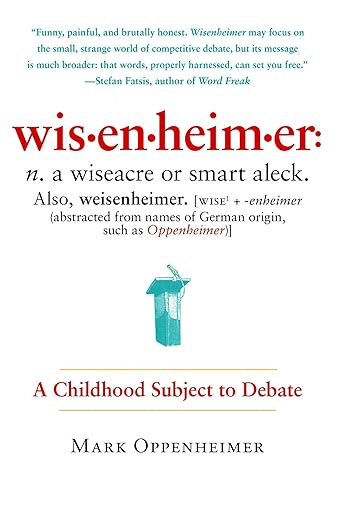
(Unlike Yglesias, I would say yes to invitations to debate. ’Cause it’s fun.)
Where has all the rock journalism gone? Oh, here it is!
One of my consistent complaints about life as we know it is that nobody is writing the rock journalism I want and need, the kind that I used to get from Rolling Stone in its heyday, Spin, etc. The websites that cover music—often well—do so in little listicles or, simply, shorter articles than I would like. I find a long rock-musician profile to be, for reasons I can’t quite put my finger on, incredibly soothing, the kind of writing I can really relax into. I think it may have something to do with my having nothing at stake: I am not a rock critic (most of the time), I have no friends in the business, I am not a groupie, I don’t follow any band around the country and never did—I’m just a fan, and so I can read about rock music for the sheer pleasure of it. The 5,000-word piece about a band or a singer, really well written, is just manna. The last piece to really nail it for me was Amanda Petrusich’s article on Phish in The New Yorker; I finished it and thought, More, please.
Then it happened again. The very fine writer Steven Hyden, whose book 2018 book Twilight of the Gods: A Journey to the End of Classic Rock is a total delight, told me, via his Substack, about his review of Oasis’s Wembley show for the website Uproxx. I have never been able to figure out what Uproxx is, who reads it, or why it exists (it seems to be some sort of branding studio, founded by Will.i.am)—but hey, they run Steven Hyden on Oasis’s reunion, so fine by me.
How to grammar good
The dirty secret among writers is that, when we’re fortunate enough to be interviewed, we prefer to talk about the craft of writing rather than the specific subject matter of our latest book or article, which we are no doubt sick of. It was thus a treat to be a guest on this podcast, on which the host asked me about my writing process, where I like to write, what flavor shots I like in the coffee I drink while I write, that sort of thing…
So they aren’t reading Jews—are they reading Gentiles?
I got a lot of thoughtful mail about my Yale/Jewish/DEI post. Here’s an excerpt from an email I got from a Major Literature Professor:
It’s not just the Jewish writers who have receded from the syllabus: Updike, Cheever, Lowell, Berryman, Pynchon, even Nabokov don’t show up nearly as often they once did, if at all. The shape of the postwar canon has shifted, and that seems to me the more complicated (and telling) story.
I have a few disjointed responses to my correspondent:
I think Nabokov may be an exception. From what I can tell, there is still a lot of Lolita-reading going on out there (my daughter read it in high school English two years ago, to take one example). For sure, the humanities and reading are in trouble, but to the extent that there are still serious readers, reading within one canon or another, I think they feel they should encounter Nabokov. He has also been helped by the pushback against book-banning, the rise of classes on “dangerous books,” etc. If you want to give the middle finger to the censors, reading Lolita remains one of the best ways.
Interesting how many of the relevant goyim are short-story writers (along with a couple poets). Updike and Cheever—and I would add Raymond Carver and Flannery O’Connor, wouldn’t you? And I think one thing that’s happened is that the short story has had a bit of a decline. The last big book of short stories that I remember landing the way that so many books of short stories used to land—Carver’s books, the big Cheever collection, Roth’s Goodbye, Columbus—was Adam Haslett’s collection, You Are Not a Stranger Here, in 2002. Has there been another short story collection that has been the talk of the town, even to the extent that a novel still can be (cf. Sally Rooney, Miranda July, Knausgard)? I don’t think we are in a short-story moment, which of course is bad news for Wasps like Cheever and Updike, not to mention Catholics like O’Connor, and Jews like Malamud (who is my favorite of the canonical Jewish American, or American Jewish, writers).
Since we are talking about canons, I want to make what to me is the essential point about canons, which is that they are not necessarily the “best” books, but simply the ones we have agreed to have in common. What’s nice about everyone once having read, say, The Grapes of Wrath or To Kill a Mockingbird was not that these were superior books of their time, but that you could find a lot of people to talk about them with. I’m not sure that means quality doesn’t matter at all, only that quality is subjective, and tastes change, but having books in common—say, the books that you and all your classmates read in a common-core curriculum—simply makes for a lot of good conversations over the years. This is why book clubs are fun, too.
“Partner”? You mean “wife” or “husband”?
This is a subject for a future post, but I really am baffled by the rise of “partner” for “spouse,” “husband,” or “wife.” I think there are some politics at play in this shift, but I am not entirely sure what they are. I will be thinking on it. Meanwhile, for an example of what I am talking about, see here.